New Mexico Solar Farm Insurance
8:30am - 5:00pm Mon-Fri
Will Reply in 15min*
Over 180+ commercial clients covered
100% customer satisfaction guaranteed
Over 10 years of business insurance experience
New Mexico's 300-plus days of sunshine make it one of the best states in the country for solar energy production, but all that sun comes with a side of risk that can blindside operators who aren't prepared. Hailstorms that crack panels in minutes, wildfire seasons that stretch longer each year, and wind gusts that can rip mounting hardware off its footings: these aren't hypothetical scenarios. They're annual realities across the state's high-desert terrain.
If you own or operate a
solar installation here, your insurance program needs to account for every one of those threats, plus the liability and revenue risks that come with running a
power-generating business. A solid policy for
solar farm insurance in New Mexico should address property damage, business interruption, and liability in equal measure. The
renewable energy insurance market is shifting in your favor right now, with
rate reductions reaching high single digits to 25% or more for well-managed portfolios. But assets sitting in high-risk zones without proper mitigation won't see those discounts. This guide breaks down the specific perils, coverage types, and pricing factors you need to understand before signing a policy.
New Mexico's geography creates a concentrated mix of weather hazards that most other solar markets don't face simultaneously. The eastern plains sit squarely in "Hail Alley," where springtime supercells routinely produce stones large enough to shatter tempered glass. The western and southern regions deal with extreme wind events and dust storms that sandblast panel surfaces and degrade electrical connections over time. And nearly every corner of the state faces wildfire exposure that's growing worse, not better.
Understanding these risks isn't just about buying the right policy. It shapes how you design your array, where you place it, and what mitigation steps you take before a single panel goes live. Insurers pay close attention to all of it.
High-Desert Weather Hazards: Hail, Wind, and Dust
Hail is the single most common cause of physical damage claims for solar farms across the Great Plains, and New Mexico's eastern corridor gets hit hard between April and July. A single storm can destroy hundreds of panels in under ten minutes, leaving you with six-figure replacement costs and weeks of lost generation. Bifacial panels and hail-resistant glass options exist, but they cost more upfront, and not every insurer gives you credit for installing them.
Wind is the other persistent threat. Gusts above 60 mph aren't unusual during spring storm season, and they stress racking systems, loosen wiring, and can send unsecured equipment tumbling across a site. Dust storms compound the problem by coating panels, reducing output, and working abrasive particles into tracker mechanisms. Your policy needs to cover not just the catastrophic event but the incremental damage these conditions cause over a season.
Wildfire Exposure for Rural Solar Arrays
Most utility-scale solar projects in New Mexico sit on rural land surrounded by dry grassland, juniper, or piñon. That puts them directly in the path of wildfire. In May 2026, the governor declared a statewide drought and severe fire condition emergency due to extreme risk across the state, coordinating community and water protection efforts at the state level.
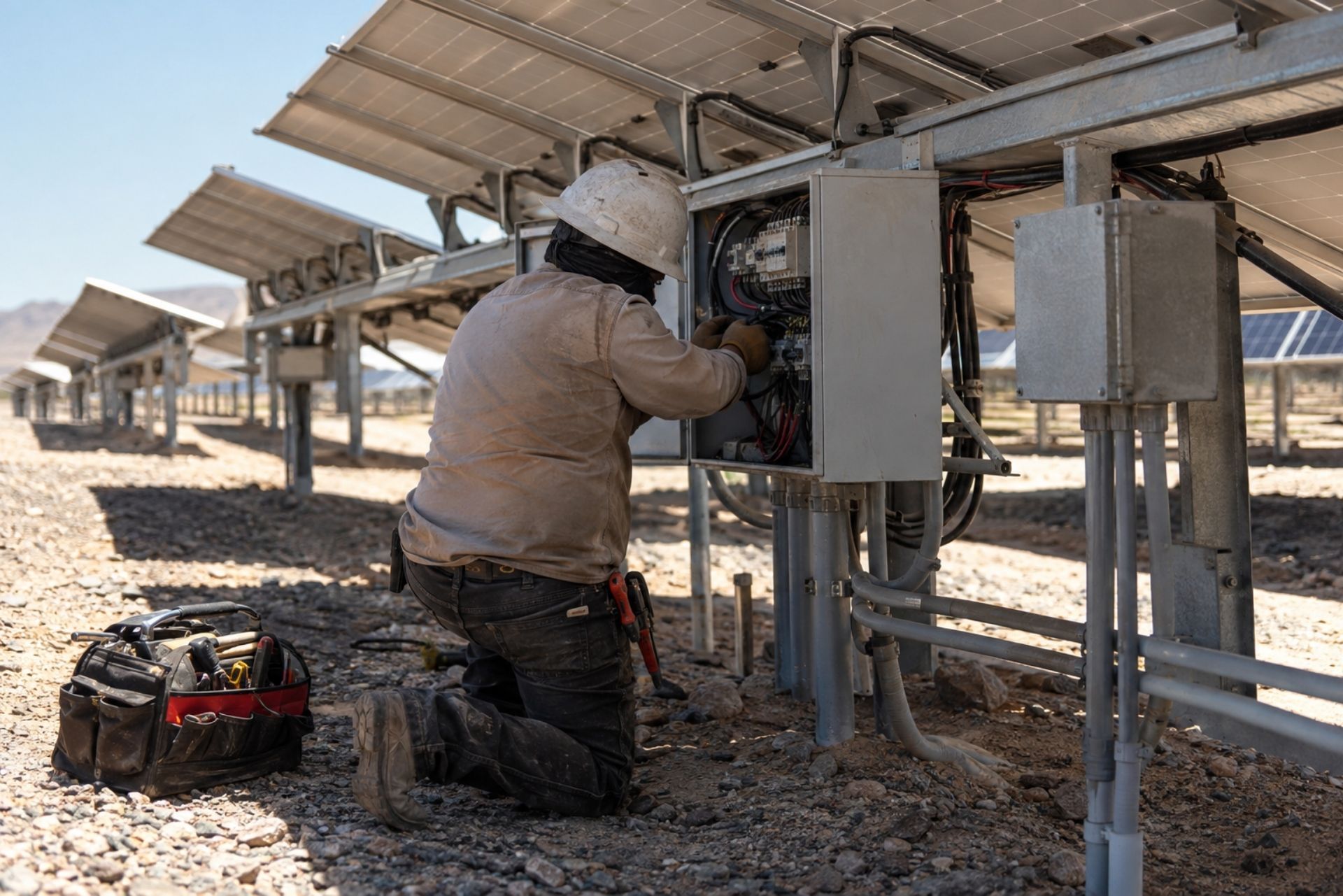
For solar operators, wildfire doesn't just threaten panels. It can destroy inverters, transformers, underground cabling, perimeter fencing, and access roads. Even if your array survives the flames, smoke and ash residue can reduce output for weeks. Insurers increasingly require defensible space plans, vegetation management schedules, and sometimes on-site water storage before they'll write a policy for rural New Mexico solar projects.

By: Dax Kastrin
Founder and Agent at ERM Insurance
Essential Coverage Types for Solar Operations
A single "solar insurance" policy doesn't exist as a standard product. You're typically assembling a program from several coverage lines, each addressing a different slice of your risk. Getting the mix wrong leaves gaps that show up at the worst possible time: right after a loss.
General Liability vs. Professional Liability
General liability covers third-party bodily injury and property damage. If a visitor trips over a cable run at your site, or a panel detaches in a storm and damages a neighbor's fence, GL responds. Most power purchase agreements and land leases require specific liability limits to be maintained.
Professional liability (sometimes called errors and omissions) is a different animal. It covers claims arising from your professional services or advice: incorrect system design, faulty energy production estimates, or failure to meet contractual performance guarantees. The New Mexico PRC's comprehensive revisions to the Community Solar Rule have increased ongoing compliance obligations for subscriber organizations, which directly raises the professional liability risk profile for community solar operators.
Physical Property and Inland Marine Coverage
Property coverage protects your panels, inverters, transformers, racking, and balance-of-system equipment against named perils like fire, wind, hail, theft, and vandalism. For solar farms, inland marine coverage often fills in the gaps, especially for equipment in transit or during installation before a permanent property policy kicks in.
One common mistake: underinsuring your equipment at depreciated value rather than replacement cost. A five-year-old inverter might be worth $40,000 on paper, but replacing it with a current model that meets updated code requirements could run $70,000 or more. Make sure your policy reflects what it actually costs to get back online, not what your accountant says the equipment is worth today.
Business Interruption and Loss of Revenue
This is the coverage most solar operators underestimate. If a hailstorm takes out a section of your array, the property policy pays for new panels. But who covers the revenue you lose during the eight to twelve weeks it takes to source replacements, schedule installation, and pass inspection?
Business interruption insurance does. It pays for the income you would have generated during the downtime, typically based on historical production data or contracted PPA rates. For a 5 MW facility, even a two-month outage creates a serious cash flow problem. Make sure your waiting period (the deductible equivalent for BI coverage) is short enough to actually help.
Comparing Coverage Levels for New Mexico Projects
Not every solar farm needs the same depth of protection. A 500 kW community solar garden has a very different risk profile than a 100 MW utility-scale installation. The table below shows how standard and comprehensive programs typically differ.
Table: Standard vs. Comprehensive Solar Protection
| Coverage Feature | Standard Program | Comprehensive Program |
|---|---|---|
| Property Perils | Named perils only (fire, wind, hail, theft) | All-risk with fewer exclusions |
| Valuation Basis | Actual cash value | Full replacement cost |
| Business Interruption | Standard limit and waiting period | 12-month limit, 14-day waiting period (https://cacgroup.com/wp-content/uploads/2026/01/CAC-2026-State-of-the-Market-3.pdf) |
| General Liability | Standard occurrence / aggregate limits | Higher occurrence / aggregate limits |
| Professional Liability | Not included | Standard limits with regulatory defense |
| Wildfire Sublimit | Often capped at 50% of property limit | Full property limit applies |
| Equipment Breakdown | Excluded or sublimited | Included with full limits |
| Flood/Flash Flood | Excluded | Available via endorsement |
The right level depends on your financing requirements, PPA terms, and how much risk you can absorb out of pocket. Lenders on larger projects almost always require comprehensive coverage.
Your premium isn't just a function of how many megawatts you're insuring. Underwriters dig into the details of your site, your equipment choices, and your operational practices. Two identically sized projects in New Mexico can see premiums vary significantly based on these factors.
System Design and Equipment Quality
Insurers care about your panel manufacturer's warranty track record, your inverter brand's failure rates, and whether your racking system is engineered for the wind loads common in your specific county. Tier-1 panel manufacturers with solid financial backing get better rates than budget brands with thin warranties.
Tracker systems versus fixed-tilt arrays also affect pricing. Trackers have more moving parts and more potential failure points, but they can also stow panels flat during hail events, which some underwriters reward with lower deductibles. If your system includes battery storage, expect a separate line item: lithium-ion fire risk is priced independently and can add meaningful cost to your program.
Proximity to Emergency Services and Fire Hydrants
Here's a factor that surprises many operators. Underwriters use ISO protection class ratings, which factor in your distance from the nearest fire station and water supply. A solar farm 20 miles from the closest volunteer fire department in a rural New Mexico county will pay more than one located five miles from a staffed station with hydrant access.
You can't move your project closer to a fire station, but you can improve your rating by installing on-site fire suppression equipment, maintaining cleared access roads, and documenting your emergency response plan. Some operators negotiate mutual aid agreements with local fire departments, which underwriters view favorably.
New Mexico Solar Insurance FAQs
Do I need special insurance for a community solar project?
Yes. Community solar projects carry subscriber-facing obligations that standard utility-scale policies don't address. The New Mexico PRC's updated Community Solar Rule revisions increase accountability for subscriber organizations, making professional liability coverage a practical necessity rather than a nice-to-have.
How does New Mexico's climate affect my deductible?
Expect higher percentage-based deductibles for wind and hail, often 2% to 5% of insured value (https://descartesunderwriting.com/industries/k-12-schools-and-higher-education), compared to flat deductibles for fire or theft. In counties with frequent severe weather, some carriers impose separate named-storm deductibles that can run even higher.
Does insurance cover panels damaged by sandstorms?
It depends on your policy language. All-risk policies generally cover windblown sand and dust damage unless specifically excluded. Named-peril policies may not, since "sandstorm" isn't always a listed peril. Check whether your policy includes "windstorm" broadly enough to encompass dust and sand events, and ask your broker to confirm in writing.
Will my policy pay out if the sun doesn't shine enough?
Standard insurance policies don't cover low irradiance or cloudy seasons. That's a production risk, not an insurable peril. Some operators purchase parametric weather products or solar resource insurance separately, but these are specialty instruments, not part of a typical property and casualty program.
Getting the right insurance for a New Mexico solar farm takes more than calling one carrier and accepting their quote. Start by documenting your site's specific hazards: hail history, wildfire proximity, flood zone status, and distance from emergency services. This information shapes every quote you'll receive, and having it organized upfront speeds the process.
Work with a broker who specializes in renewable energy, not a generalist commercial agent. Renewable energy programs have unique coverage triggers, valuation methods, and exclusions that general brokers often miss. Ask for at least three competing quotes, and compare them on coverage terms, not just premium price. A policy that's $5,000 cheaper but caps your wildfire sublimit at half your property value isn't actually saving you money.
The broader insurance market is softening for well-mitigated solar assets, but projects in high-risk zones without strong mitigation plans face stable or even increasing rates. Your best move is to invest in defensible space, quality equipment, and a thorough emergency plan before you start shopping for coverage. The premium savings will pay for those investments faster than you'd expect.
About The Author:
Dax Kastrin
As Founder and Agent at ERM Insurance, I’m committed to helping clients understand and manage risk through clear, straightforward coverage solutions. With professional designations as an Accredited Advisor in Insurance (AAI) and Associate in General Insurance (AINS), I focus on delivering dependable protection and personalized service for every individual and business I work with.
Your Business Insurance Solutions

Workers’ Compensation Insurance
Protect your workers from significant financial losses if they are injured or disabled while performing their duties as an employee.

Cyber Liability Insurance
Safeguard your business against financial losses from data breaches, especially those that involve sensitive customer information and other unforeseen cyber events, like cybercrime.

Directors & Officers Liability
Protect your C-suite officers and board members, as well as the companies they represent if they are the subject of a claim or investigation from their duties.

General Liability Insurance
Guard your business against the cost of claims that can be filed due to bodily injury to a third party, damage to third-party property, lawsuits, and more.

Business Owners Insurance
Reduce the cost of premiums by getting a business owner’s insurance, a coverage plan that combines commercial property insurance and general liability insurance.

Commercial Auto Insurance
Guard your business against financial losses from accidents involving company vehicles. Commercial auto insurance provides for bodily injury liability and property damage.

Commercial Property Insurance
Recover from financial losses involving damage to your physical assets, including furniture, physical building, office space, inventory, landscaping and fencing, signage, and more.

Lessor's Risk Insurance
Get coverage for your rental properties. A lessor’s risk insurance covers financial losses from acts of vandalism, litigation costs for lawsuits, theft of property owned by your tenants, and more.

Product Liability Insurance
Protect your companies from claims made against the goods you provide. This covers injuries caused by malfunctions of products, design defects, and more.
Choose Elemental Risk Management Today
Get a Plan Suited to Your Business
ERM assesses the risks that your company faces, as well as your industry, operations, workforce, and more.
Recover Quickly
With business insurance coverage, you’ll bounce back from adverse events that could have left your business on the brink of bankruptcy.
Avoid Overpaying
Through customized solutions, your business will get adequate coverage without unnecessary costs. We’ll keep premiums cost-effective.
Our Testimonials
Hear from our clients
“We recently changed our business insurance after over 20 years, and we couldn't be happier. We didn't realize how poor the service was, how unresponsive, and slow the service was of our previous carrier. Dax and his team have gone above and beyond to answer every question our business had, to ensure that we had the coverage we needed, and fully understood everything we were getting. Not only did we save money, but we have saved a lot of time with the quick responsiveness of this team. They are exceptional. Would Highly recommend, and provide references."
Laura Harrison
May 2021
"I love working with the ERM crew! They are always super inquisitive and willing to learn/ask questions to provide their clients with the best possible insurance solution. I would definitely recommend them to anyone looking for advice on their current policies and coverage."
Nicole Limpert
May 2021
“Elemental Risk Management has been our insurance agent for 2 years now. They are consistently shopping for us to have the very best quality of coverage, as well as the best rates available. They saved our company over $20,000.00 in premiums our first year doing business with them. They are also quick to respond to any need (COI's, accident reporting, etc.). I recommend the team at ERM very highly!
Ramona Mills
June 2021