California Drone and Aerial Mapping Insurance
8:30am - 5:00pm Mon-Fri
Will Reply in 15min*
Over 180+ commercial clients covered
100% customer satisfaction guaranteed
Over 10 years of business insurance experience
Flying a $30,000 drone equipped with a LIDAR sensor over a California construction site isn't the same as shooting
real estate photos with a consumer quadcopter. The insurance you need reflects that difference. California drone operators working in aerial mapping face a unique mix of federal aviation rules, state-specific legislation, and client contract requirements that
standard business policies simply don't address. If you're a surveyor,
GIS professional, or mapping company owner, your equipment is expensive, your data carries real liability, and one crash in a crowded metro area could wipe out your business. This guide to drone operator and aerial mapping insurance coverage in California breaks down what you actually need, what you can skip, and where operators commonly get burned by coverage gaps. The drone analytics market is
projected to reach $11.8 billion by 2030, and California is one of the largest markets driving that growth. With more operators entering the field, competition for contracts is fierce, and clients are asking tougher questions about your insurance before they'll sign. Whether you're bidding on a CalTrans corridor survey or
mapping agricultural parcels in the Central Valley, your coverage package sends a signal about your professionalism. Getting it right from the start saves you money, protects your reputation, and keeps you flying.
Understanding Drone Insurance Requirements in California
California has layered its own regulations on top of federal drone rules, creating a compliance environment that catches many operators off guard. You're not just answering to the FAA here. The state has taken an active interest in how drones interact with privacy, property, and insurance markets. Understanding both layers is essential before you purchase any policy.
FAA Part 107 Compliance vs. State Regulations
Your Part 107 certificate is the baseline. It lets you fly commercially, but it doesn't require you to carry insurance. That's a federal decision, not a state one. California doesn't mandate drone liability insurance by statute either, but the practical reality is different: most clients, landowners, and municipalities won't let you fly without proof of coverage.
California has passed laws that directly affect how drone imagery intersects with insurance. AB 75 and AB 1559 require insurers to notify homeowners 30 days before using aerial imagery for underwriting and prohibit basing coverage decisions solely on drone-captured data. These laws were designed to protect homeowners, but they also signal how seriously California treats aerial data collection. If you're the operator capturing that imagery, you're sitting at the intersection of privacy law, data liability, and aviation regulation.
Why General Liability Isn't Enough for Aerial Mapping
A standard general liability policy covers slip-and-fall incidents at your office or damage you cause while walking around a job site. It doesn't cover aircraft operations. Drones are classified as aircraft by the FAA, and most general liability policies contain an aviation exclusion that voids coverage the moment your drone leaves the ground.
You need an aviation-specific liability policy that explicitly covers unmanned aircraft systems. This is non-negotiable. Even if your general liability insurer says they "cover drones," read the endorsement carefully. Many add drone coverage as a sub-limit with restrictions that make it nearly useless for professional mapping work, like $25,000 caps on equipment or exclusions for sensors attached to the airframe.


By: Dax Kastrin
Founder and Agent at ERM Insurance
Key Coverage Types for Aerial Mapping Professionals
A complete insurance package for aerial mapping work in California typically includes three to four distinct policy types. Each one protects against a different category of risk, and skipping any of them leaves a gap that could cost you tens of thousands of dollars.
Hull Insurance for Expensive Mapping Sensors
Hull insurance covers physical damage to your drone and its attached equipment. For mapping professionals, this is where the real value sits. Your airframe might cost $5,000 to $15,000, but the LIDAR unit, multispectral camera, or photogrammetry sensor mounted to it could be worth two or three times that amount.
Make sure your hull policy covers attached sensors as part of the insured aircraft, not just the airframe itself. Some policies treat sensors as "removable equipment" and exclude them or apply a separate, lower sub-limit. Maintenance records matter here too: insurers may deny claims if you can't demonstrate proper upkeep, since maintenance lapses directly affect how claims are evaluated.
Professional Liability and Data Errors
This is the coverage type most mapping operators underestimate. Professional liability, sometimes called errors and omissions insurance, protects you when your deliverable contains mistakes. If your orthomosaic has a stitching error that causes a grading contractor to move 500 extra cubic yards of dirt, you're looking at a five-figure claim.
Aerial mapping data feeds into engineering decisions, construction plans, and regulatory filings. A boundary error on a topographic survey can trigger property disputes. An inaccurate volumetric calculation can cost a mining client real money. Professional liability covers the financial consequences of these errors, including legal defense costs.
Personal and Advertising Injury Coverage
This coverage applies when your drone operations lead to claims of privacy invasion, trespass, or defamation. California has some of the strongest privacy protections in the country, and flying a camera-equipped drone over residential areas creates exposure that other states don't generate as aggressively.
Personal and advertising injury coverage is typically included as part of a commercial general liability policy, but confirm that it applies to drone operations specifically. Some aviation policies exclude it, assuming it's handled by your ground-based CGL. If both policies exclude it, you have a gap.
Comparing Coverage: Basic Liability vs. Full Professional Mapping Suite
Choosing between a bare-minimum liability policy and a comprehensive mapping insurance package comes down to your risk tolerance, your client base, and the value of your equipment. Here's how the two approaches compare side by side.
Comparison Table: Features and Protection Limits
| Coverage Feature | Basic Liability Only | Full Professional Mapping Suite |
|---|---|---|
| Third-party bodily injury | $1M per occurrence | $1M-$5M per occurrence |
| Third-party property damage | $1M per occurrence | $1M-$5M per occurrence |
| Third-party property damage | Not included | Full replacement value |
| Sensor and payload coverage | Not included | Included (verify sub-limits) |
| Professional liability (E&O) | Not included | $1M-$2M per claim |
| Personal/advertising injury | Sometimes included | Included |
| Inland marine (ground equipment) | Not included | Covers laptops, ground stations, batteries |
| Typical annual premium | $500-$1,200 | $2,500-$7,500+ |
The basic policy keeps you legal for simple jobs. The full suite protects a real business. Most California construction and engineering clients require $2M in liability coverage and a certificate of insurance naming them as an additional insured before you set foot on their site.
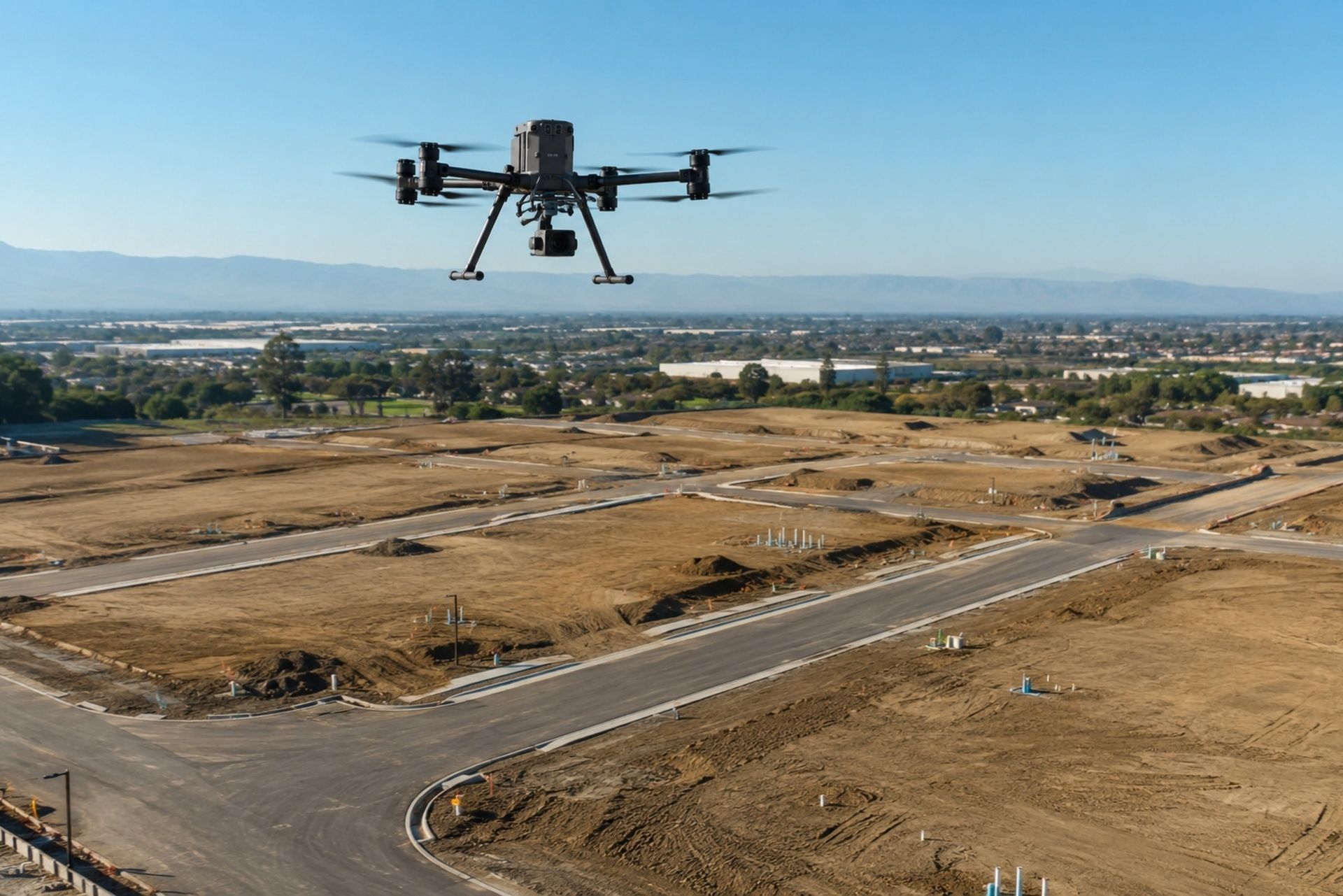
Your premium isn't just based on how many drones you own. Insurers evaluate a range of operational factors, and California's geography introduces variables that don't exist in flatter, less populated states.
Operating in High-Density Urban Environments
Flying in Los Angeles, San Francisco, or San Diego means operating near people, vehicles, and expensive property. Insurers price this risk accordingly. Urban operations can increase your premium by 20% to 40% compared to rural agricultural mapping. The logic is straightforward: a drone falling onto a parked Tesla in a Bay Area parking lot generates a very different claim than one landing in an empty almond orchard.
Controlled airspace waivers, which you'll need for most urban work, also factor in. Insurers want to see that you hold valid Part 107 waivers for night operations, flights over people, or beyond visual line of sight. On-demand insurance platforms have partnered with property inspection companies to streamline coverage for exactly these kinds of urban flight scenarios.
Wildfire Zone Considerations and Coastal Winds
California's wildfire seasons have reshaped insurance markets across the state, and drone operators aren't immune. If you're mapping in or near designated wildfire zones, your insurer may add exclusions or increase premiums. The concern isn't just that your drone could start a fire (lithium battery crashes are a real ignition risk) but also that operating in active fire zones exposes you to extraordinary liability.
Coastal wind conditions along the Pacific coast add another variable. Strong, unpredictable gusts increase crash risk, and insurers know it. Operators flying along Big Sur cliffs or the Marin Headlands should expect underwriters to ask about their wind-speed operating limits and whether their aircraft have redundant GPS and return-to-home failsafes. California's insurance regulators have been
examining how drone-collected data affects risk assessment statewide, adding another layer of regulatory scrutiny.
Common Questions About California Drone Insurance
FAQ: Do I need insurance if I only fly over private land?
Technically, no California law requires it. But the landowner will almost certainly require proof of coverage before granting access. Even on private property, you're liable for damage to third parties, structures, or vehicles. Carry at least $1M in liability coverage regardless of where you fly.
FAQ: Does my policy cover the LIDAR sensor if the drone crashes?
It depends on your hull policy's language. Some policies cover "attached equipment" automatically, while others treat sensors as separate items requiring scheduled coverage. Always list your sensors by model and value on your policy declarations page. A $40,000 LIDAR unit deserves explicit coverage.
FAQ: Is on-demand insurance better than an annual policy?
On-demand policies work well for occasional flyers, typically costing $15 to $50 per flight. But if you're flying more than twice a month, an annual policy is almost always cheaper. On-demand policies also tend to offer lower limits and fewer coverage types than annual plans.
FAQ: What happens if my drone accidentally records someone's backyard?
California's privacy laws are strict. If a resident files a complaint, you could face a civil lawsuit for invasion of privacy. Personal and advertising injury coverage within your policy should cover legal defense costs. That said, your best protection is operational: fly with camera angles that minimize incidental capture of private spaces.
FAQ: How much liability coverage do California construction clients usually ask for?
Most
general contractors and engineering firms require $1M to $2M per occurrence, with $2M being the standard for larger projects. Some public works contracts push that to $5M. Always ask about insurance requirements before you bid on a project, because
coverage gaps create real problems for drone mapping professionals when claims arise.

Making the Right Choice for Your Mapping Business
The right insurance package for your California aerial mapping operation isn't the cheapest one or the most expensive one. It's the one that matches your actual risk profile. If you're flying a $3,000 Phantom over open farmland, a basic liability policy with on-demand hull coverage might be enough. If you're operating a $60,000 mapping rig over downtown Sacramento construction sites, you need the full suite: hull, liability, professional E&O, and inland marine for your ground equipment.
Get quotes from at least three aviation-specific insurers, not general business insurance brokers. Ask each one how they handle sensor coverage, whether they offer per-project additional insured endorsements, and what their claims turnaround looks like. Review your policy annually, especially if you've added equipment, expanded into new service areas, or started flying in controlled airspace.
Your insurance isn't just a cost of doing business. It's what keeps your business alive when something goes wrong at 400 feet. Invest the time to get it right, and you'll fly with the confidence that one bad day won't end everything you've built.
About The Author:
Dax Kastrin
As Founder and Agent at ERM Insurance, I’m committed to helping clients understand and manage risk through clear, straightforward coverage solutions. With professional designations as an Accredited Advisor in Insurance (AAI) and Associate in General Insurance (AINS), I focus on delivering dependable protection and personalized service for every individual and business I work with.
Your Business Insurance Solutions

Workers’ Compensation Insurance
Protect your workers from significant financial losses if they are injured or disabled while performing their duties as an employee.

Cyber Liability Insurance
Safeguard your business against financial losses from data breaches, especially those that involve sensitive customer information and other unforeseen cyber events, like cybercrime.

Directors & Officers Liability
Protect your C-suite officers and board members, as well as the companies they represent if they are the subject of a claim or investigation from their duties.

General Liability Insurance
Guard your business against the cost of claims that can be filed due to bodily injury to a third party, damage to third-party property, lawsuits, and more.

Business Owners Insurance
Reduce the cost of premiums by getting a business owner’s insurance, a coverage plan that combines commercial property insurance and general liability insurance.

Commercial Auto Insurance
Guard your business against financial losses from accidents involving company vehicles. Commercial auto insurance provides for bodily injury liability and property damage.

Commercial Property Insurance
Recover from financial losses involving damage to your physical assets, including furniture, physical building, office space, inventory, landscaping and fencing, signage, and more.

Lessor's Risk Insurance
Get coverage for your rental properties. A lessor’s risk insurance covers financial losses from acts of vandalism, litigation costs for lawsuits, theft of property owned by your tenants, and more.

Product Liability Insurance
Protect your companies from claims made against the goods you provide. This covers injuries caused by malfunctions of products, design defects, and more.
Choose Elemental Risk Management Today
Get a Plan Suited to Your Business
ERM assesses the risks that your company faces, as well as your industry, operations, workforce, and more.
Recover Quickly
With business insurance coverage, you’ll bounce back from adverse events that could have left your business on the brink of bankruptcy.
Avoid Overpaying
Through customized solutions, your business will get adequate coverage without unnecessary costs. We’ll keep premiums cost-effective.
Our Testimonials
Hear from our clients
“We recently changed our business insurance after over 20 years, and we couldn't be happier. We didn't realize how poor the service was, how unresponsive, and slow the service was of our previous carrier. Dax and his team have gone above and beyond to answer every question our business had, to ensure that we had the coverage we needed, and fully understood everything we were getting. Not only did we save money, but we have saved a lot of time with the quick responsiveness of this team. They are exceptional. Would Highly recommend, and provide references."
Laura Harrison
May 2021
"I love working with the ERM crew! They are always super inquisitive and willing to learn/ask questions to provide their clients with the best possible insurance solution. I would definitely recommend them to anyone looking for advice on their current policies and coverage."
Nicole Limpert
May 2021
“Elemental Risk Management has been our insurance agent for 2 years now. They are consistently shopping for us to have the very best quality of coverage, as well as the best rates available. They saved our company over $20,000.00 in premiums our first year doing business with them. They are also quick to respond to any need (COI's, accident reporting, etc.). I recommend the team at ERM very highly!
Ramona Mills
June 2021