Colorado Mixed Use Building LRO Insurance
8:30am - 5:00pm Mon-Fri
Will Reply in 15min*
Over 180+ commercial clients covered
100% customer satisfaction guaranteed
Over 10 years of business insurance experience
Owning a mixed-use building in Colorado means juggling two worlds under one roof: retail shops,
restaurants, or offices on the lower floors, and
residential tenants above. That split creates insurance challenges most standard policies don't address well. A Lessor's Risk Only policy, commonly called LRO, is designed for property owners who lease space to others rather than occupying it themselves. It's a distinct product built around your role as landlord, not business operator. For Colorado owners specifically, the combination of severe weather exposure, evolving state regulations, and the complexity of mixed occupancy types makes choosing the right LRO coverage a high-stakes decision. The good news? Commercial property insurance rates have been
falling through mid-2026, which means you have more room to negotiate strong coverage without overpaying. But cheaper premiums only help if you're buying the right policy. This guide breaks down what
LRO insurance covers for Colorado mixed-use buildings, how to handle the state's unique risks, and what to look for when comparing policy tiers.
Understanding LRO Insurance for Colorado Mixed-Use Properties
LLRO insurance sits in a specific niche. It protects you as the building owner and landlord, covering the structure, common areas, and your liability exposure, while your tenants carry their own policies for their business operations or personal belongings. For a mixed-use property, this distinction matters enormously because you're housing fundamentally different risk profiles under one deed.
What is Lessor's Risk Only (LRO) Coverage?
An LRO policy is a commercial insurance product tailored for property owners who don't conduct business operations inside their buildings. If you own a three-story building in Denver with a coffee shop on the ground floor and four apartments upstairs, your LRO policy covers the physical structure, your liability as landlord, and income you'd lose if a covered event forced tenants out.
Your tenants' inventory, equipment, and their own liability? That's on them. The coffee shop needs its own business owner's policy. Your residential tenants should carry renters insurance. This clean separation is what makes LRO policies work, but it also means gaps can appear if lease agreements don't require tenant coverage. We've seen claims where a tenant's grease fire damaged the building, and the owner's LRO policy covered structural repairs but couldn't recover costs from the tenant because no insurance requirement existed in the lease.
Why Colorado Property Owners Need Specialized Policies
Colorado's insurance environment has shifted considerably in recent years. A state law aimed at reducing property insurance costs went into effect to address affordability concerns, reflecting how much premiums had climbed due to wildfire and hail losses. Mixed-use buildings face compounded risk because residential and commercial tenants generate different claim patterns.
A restaurant creates grease fire and slip-and-fall exposure. Apartments bring water damage from plumbing failures and liability from common hallways. Standard commercial property policies often treat mixed-use buildings as a single risk class, which can leave you underinsured on one side or overpaying on the other. Colorado-specific LRO policies account for this dual nature, and carriers familiar with the state's weather patterns price hail and wind coverage more accurately than national one-size-fits-all products.

By: Dax Kastrin
Founder and Agent at ERM Insurance
Core Coverages for Mixed-Use Buildings
Your LRO policy for a mixed-use property should include three essential layers. Missing any one of them can turn a manageable incident into a financial crisis.
General Liability for Common Areas
You're responsible for shared spaces: lobbies, stairwells, parking areas, sidewalks, and elevators. If a visitor slips on an icy walkway outside your building in Colorado Springs, that claim lands on your liability coverage, not your tenant's. Most LRO policies include general liability limits of $1 million per occurrence and $2 million aggregate, though buildings with heavy foot traffic or multiple commercial tenants may need higher limits.
One common mistake we see is owners assuming their commercial tenant's liability policy extends to the shared entrance or parking lot. It doesn't. Your policy covers the common areas, and your lease should clearly define where your responsibility ends and the tenant's begins.
Property Insurance and Replacement Cost
Property coverage protects the building itself, including walls, roof, HVAC systems, plumbing, and any fixtures you own. The critical choice here is between actual cash value and replacement cost. Actual cash value deducts depreciation, meaning a 15-year-old roof destroyed by hail gets valued at its depreciated worth, not what it costs to install a new one.
For mixed-use buildings, replacement cost coverage is almost always the better option. Construction costs in Colorado's Front Range have remained elevated, and rebuilding a mixed-use structure with both commercial and residential code requirements adds complexity and expense. Make sure your coverage limit reflects current reconstruction costs, not the purchase price or tax assessment.
Loss of Rental Income Protection
If a fire or major storm makes your building uninhabitable, your mortgage doesn't pause. Loss of rental income coverage, sometimes called business income coverage, replaces the rent you would have collected during repairs. For a mixed-use building generating $15,000 per month across commercial and residential units, even a four-month repair timeline means $60,000 in lost income.
Check your policy's waiting period and maximum recovery period. Some policies cap income replacement at 12 months, which might not be enough for a building requiring extensive reconstruction. Colorado's hail season can create contractor backlogs that stretch timelines well beyond initial estimates.
UColorado's geography creates insurance challenges you won't find in most other states. The combination of severe convective storms along the Front Range and wildfire exposure in mountain and foothill communities means your LRO policy needs to account for risks that can change block by block.
Hail and Wildfire Mitigation Strategies
Hail is Colorado's most frequent and costly natural hazard for commercial properties. The state regularly ranks among the top three nationally for hail damage claims. Impact-resistant roofing materials, rated Class 4, can earn premium discounts of 15% to 30% depending on your carrier. If you're replacing a roof anyway, the upgrade pays for itself through insurance savings within a few years.
Wildfire risk depends heavily on location. Properties in the wildland-urban interface face higher premiums and sometimes struggle to find coverage at all. Defensible space around your building, fire-resistant exterior materials, and ember-resistant vents all help. Some Colorado insurers now offer specific wildfire mitigation credits, rewarding property owners who take proactive steps rather than simply penalizing those in high-risk zones.
Managing Residential vs. Commercial Tenant Risks
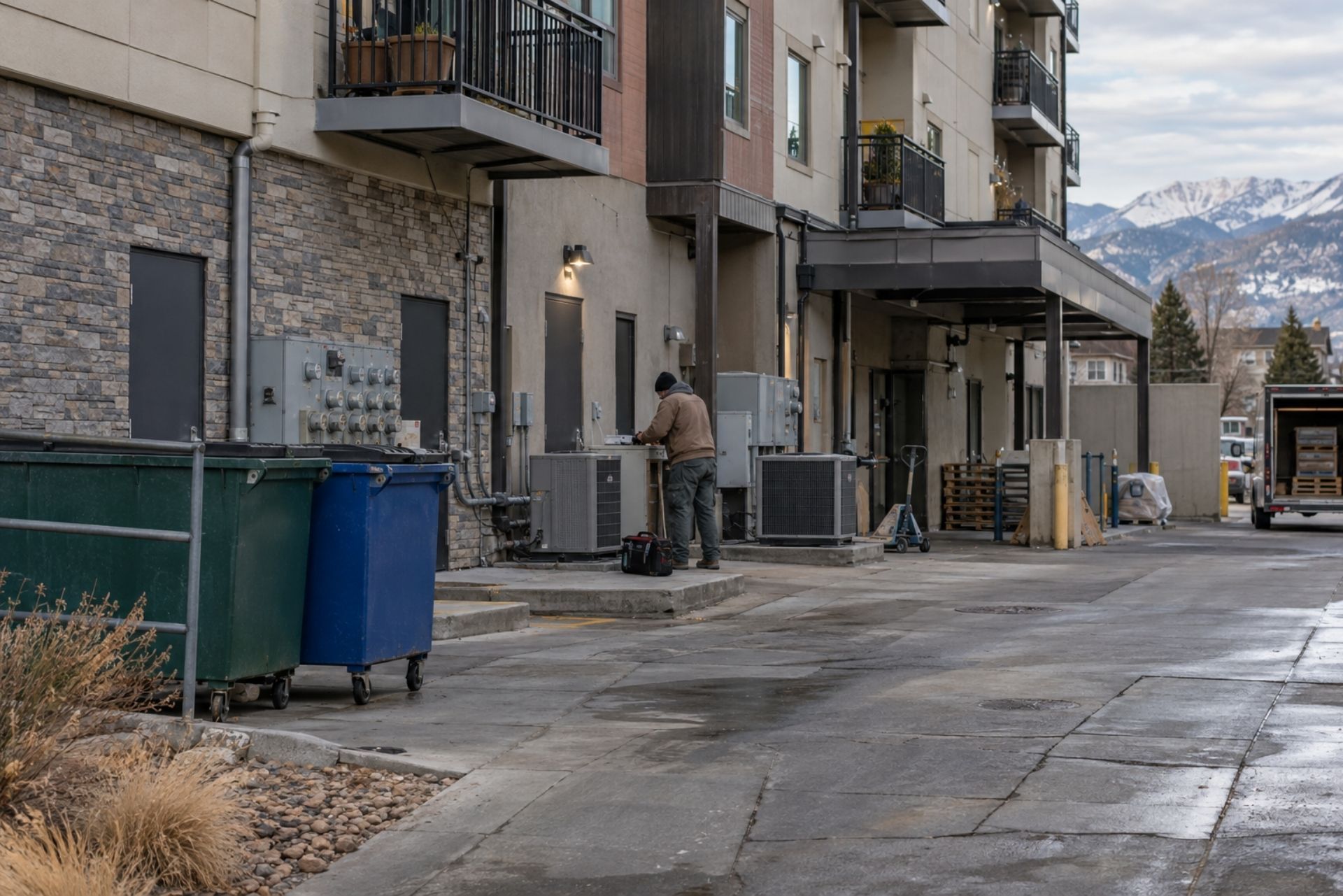
Your commercial tenants and residential tenants create different liability and property damage exposures. A ground-floor restaurant with a commercial kitchen presents fire and grease trap risks. An upstairs apartment tenant might overflow a bathtub, sending water cascading into the retail space below.
Strong lease language is your first line of defense. Require every commercial tenant to carry a minimum of $1 million in general liability and name you as an additional insured on their policy. Require residential tenants to maintain renters insurance with at least $100,000 in liability coverage. These requirements don't just protect you, they also speed up the claims process when incidents involve multiple parties.
Comparing LRO Policy Tiers
Not all LRO policies offer the same depth of protection. Understanding the difference between basic and comprehensive tiers helps you match coverage to your building's actual risk profile.
Basic vs. Comprehensive Coverage Table
| Coverage Feature | Basic LRO | Comprehensive LRO |
|---|---|---|
| Building Coverage | Named perils only | All-risk (open perils) |
| Liability Limits | $500K/$1M | $1M/$2M or higher |
| Loss of Income | 6-month cap | 12-month or extended |
| Hail/Wind Deductible | Percentage-based (2-5%) | Flat dollar or lower percentage |
| Equipment Breakdown | Not included | Included |
| Ordinance/Law Coverage | Not included | Included (covers code upgrades) |
| Flood/Earthquake | Excluded | Optional endorsement |
The ordinance and law coverage line deserves special attention. If your mixed-use building suffers major damage and the city requires you to rebuild to current codes, including updated fire suppression, ADA compliance, or energy efficiency standards, a basic policy won't cover those upgrade costs. For older buildings in Denver, Boulder, or Fort Collins, this gap alone can add six figures to your out-of-pocket expense.
Commercial property rates
fell by an average of 13% in Q2 2026, following a 10% decrease earlier in the year. That downward trend means comprehensive coverage is more affordable now than it was 18 months ago. If you've been carrying a basic tier to save money, this is a good time to re-quote.
Common Questions About Colorado Mixed-Use Insurance
FAQ: Practical Answers for Property Owners
How much does LRO insurance typically cost for a Colorado mixed-use building? Premiums vary widely based on location, building age, tenant mix, and construction type. For a mid-size mixed-use property along the Front Range, expect annual premiums ranging from $3,000 to $12,000 or more, with hail-prone areas and older buildings trending toward the higher end.
Do I need a separate flood policy? Yes. Standard LRO policies exclude flood damage. If your building sits in or near a floodplain, you'll need a separate National Flood Insurance Program policy or a private flood policy.
Can I require tenants to carry insurance? You can and should. Colorado law allows landlords to require both commercial and residential tenants to maintain insurance as a lease condition. Spell out minimum coverage amounts and require proof before move-in.
What's a percentage-based wind/hail deductible? Instead of a flat dollar amount, some policies set your deductible as a percentage of the building's insured value. On a $2 million building with a 3% wind/hail deductible, you'd pay the first $60,000 out of pocket. Negotiate for a flat deductible if possible.
Does my LRO policy cover tenant improvements? Usually not, unless specifically endorsed. If a commercial tenant builds out their space, their own policy should cover those improvements. Clarify this in your lease to avoid disputes after a loss.
Should I carry an umbrella policy on top of my LRO? For most mixed-use owners, yes. A commercial umbrella adds an extra layer of liability protection, typically $1 million to $5 million, above your LRO's base limits. The cost is relatively low compared to the exposure.
Making the Right Choice for Your Investment
Choosing the right LRO insurance for a Colorado mixed-use building comes down to understanding your specific risks and not settling for a generic policy. Your building's tenant mix, location, age, and construction type all shape what you actually need.
Start by getting quotes from at least three carriers experienced with Colorado mixed-use properties. Ask specifically about hail deductible structures, ordinance and law coverage, and loss of income limits. Review your leases to make sure tenant insurance requirements are current and enforceable. And take advantage of the current softening market to upgrade from basic to comprehensive coverage if you've been holding off.
The worst time to discover a coverage gap is after a claim. A thorough policy review now, ideally with a broker who knows Colorado's mixed-use market, protects both your building and the income it generates. Get your quotes updated this year while rates are working in your favor.
About The Author:
Dax Kastrin
As Founder and Agent at ERM Insurance, I’m committed to helping clients understand and manage risk through clear, straightforward coverage solutions. With professional designations as an Accredited Advisor in Insurance (AAI) and Associate in General Insurance (AINS), I focus on delivering dependable protection and personalized service for every individual and business I work with.
Your Business Insurance Solutions

Workers’ Compensation Insurance
Protect your workers from significant financial losses if they are injured or disabled while performing their duties as an employee.

Cyber Liability Insurance
Safeguard your business against financial losses from data breaches, especially those that involve sensitive customer information and other unforeseen cyber events, like cybercrime.

Directors & Officers Liability
Protect your C-suite officers and board members, as well as the companies they represent if they are the subject of a claim or investigation from their duties.

General Liability Insurance
Guard your business against the cost of claims that can be filed due to bodily injury to a third party, damage to third-party property, lawsuits, and more.

Business Owners Insurance
Reduce the cost of premiums by getting a business owner’s insurance, a coverage plan that combines commercial property insurance and general liability insurance.

Commercial Auto Insurance
Guard your business against financial losses from accidents involving company vehicles. Commercial auto insurance provides for bodily injury liability and property damage.

Commercial Property Insurance
Recover from financial losses involving damage to your physical assets, including furniture, physical building, office space, inventory, landscaping and fencing, signage, and more.

Lessor's Risk Insurance
Get coverage for your rental properties. A lessor’s risk insurance covers financial losses from acts of vandalism, litigation costs for lawsuits, theft of property owned by your tenants, and more.

Product Liability Insurance
Protect your companies from claims made against the goods you provide. This covers injuries caused by malfunctions of products, design defects, and more.
Choose Elemental Risk Management Today
Get a Plan Suited to Your Business
ERM assesses the risks that your company faces, as well as your industry, operations, workforce, and more.
Recover Quickly
With business insurance coverage, you’ll bounce back from adverse events that could have left your business on the brink of bankruptcy.
Avoid Overpaying
Through customized solutions, your business will get adequate coverage without unnecessary costs. We’ll keep premiums cost-effective.
Our Testimonials
Hear from our clients
“We recently changed our business insurance after over 20 years, and we couldn't be happier. We didn't realize how poor the service was, how unresponsive, and slow the service was of our previous carrier. Dax and his team have gone above and beyond to answer every question our business had, to ensure that we had the coverage we needed, and fully understood everything we were getting. Not only did we save money, but we have saved a lot of time with the quick responsiveness of this team. They are exceptional. Would Highly recommend, and provide references."
Laura Harrison
May 2021
"I love working with the ERM crew! They are always super inquisitive and willing to learn/ask questions to provide their clients with the best possible insurance solution. I would definitely recommend them to anyone looking for advice on their current policies and coverage."
Nicole Limpert
May 2021
“Elemental Risk Management has been our insurance agent for 2 years now. They are consistently shopping for us to have the very best quality of coverage, as well as the best rates available. They saved our company over $20,000.00 in premiums our first year doing business with them. They are also quick to respond to any need (COI's, accident reporting, etc.). I recommend the team at ERM very highly!
Ramona Mills
June 2021